
Spiders In Grass: Why They’re There and What To Do About Them
Have spiders made their home in your grass? Are they harmful? Should you worry? This post tells you everything you need to know about spiders in your grass. In addition, if they are becoming a problem, we will show you how to get rid of them!

Many people are scared of spiders, but the truth is most of these eight-legged creatures are harmless. The majority of spiders you will find in your grass are simply looking for a place to live. In fact, they can even be helpful because they keep the insect populations under control.
We want to tell you a little bit more about why these eight-legged creatures have taken up residence on your property. We will cover the difference between the different species of spiders, so you know what kind you have. Do you want to encourage them to leave your lawn? No problem! We can show you how.
Why Are There Spiders in My Grass?
Suppose you have seen spiders roaming around in your yard. In that case, there is a good chance there is a food source for insects somewhere. This has enticed the spiders to make themselves at home somewhere on your property.
Most lawns are home to many insects, so it is the perfect hunting ground for spiders.
Do I Want Spiders in My Grass?
So, you have spiders on your lawn. Is this a good thing? Yes it is. They catch and eat insects that feed on lawn grass and are an essential part of the ecosystem. Let us focus on the positives of spiders in our grass.
Benefits of Spiders in Grass
There are several benefits to having spiders in your grass. One of the most obvious is that spiders catch and eat harmful insects, like ants and flies. Spiders are considered an essential part of the ecosystem because they help control insect populations. They also feed a large number of birds.
In addition, garden spiders may help prevent plant diseases by preventing the spread of disease. Insects transport a variety of fungal and bacterial infections from one plant to the next. The fewer insects in your garden, the less likely those particular illnesses will spread from plant to plant.
While the spiders you see in your grass may give you the shivers, the vast majority of them are entirely harmless to humans. However, suppose you have a spider phobia (no shame) or are allergic to their venom. In that case, it is understandable that you would want to get rid of them.
How Do I Get Rid Of Spiders In My Grass Naturally?
Mow lawns frequently
In 2013 scientists studying biological control in lawn turf asked the following question.
“Does mowing height matter?”
They wanted to know if the height of the grass would change the number of spiders in the grass. Over two years, the researchers compared samples of spiders between plots of grass mowed at 2.5 inches and those left at 4 inches. Spiders were significantly more abundant in vacuum samples from the high grass on all dates.
It makes sense, doesn’t it? Mowing your grass will
- Destroy the spider’s webs.
- Reduce the number of insects for spiders to feed on.
- Disrupt the spider’s lives
Spiders are like any other animal. If they cannot find what they need to survive, they will move on.
Finding this post helpful? See all our wildlife and animal posts.
Trim vegetation Around Your Lawn
In addition to regularly mowing your lawn, you should trim hedges, bushes, and flowering shrubs to discourage spiders.
Many spiders like dense vegetation because it provides protection and attracts insects. Keeping the vegetation around your home trimmed may help deter spiders.
You should also remove debris and leaves from your lawn because they serve as hiding spots for insects. Insects on your property will attract spiders.
Does it Help to Remove Webs?
You can try removing webs on the lawn, but I’m not sure it would really deter spiders. I could not find any evidence that it would work. The idea is to make your lawn less hospitable, and spiders will naturally move on, but, likely, they would just rebuild. That’s what spiders do! It’s programmed into their very being.
The best time to remove webs is when the dew is still on the ground in the early morning. This will make it easier to see the webs. Use a soft broom to brush them off the grass blades.
Pro Tip: Did you know that a grass fungus called dollar spot fungus that looks like spider webs (see the picture above). You will see it first thing in the morning. Unlike spider webs, this fungus will disappear when the dew dries. It will also leave brown spots on your lawn as the infected grass dies.
Reduce Outdoor Lighting
One study indicated that outdoor lights attract young spiders, but they only stayed in lots of prey available. Lighting attracts nighttime flying insects, which perfect spider food. For this reason, there are frequent spider webs and active hunting spiders around lighted areas. Outside areas illuminated by indoor lighting will also attract spiders. I looked at several pest control companies. Many recommend replacing existing lights with yellow bulbs and reducing the number of lights from outdoor doors and windows.
Learn more about spiders and lights? We looked at what the scientists discovered and share our findings.
Should I Clean Up Food Or Pet Food?
Spiders only eat live prey, and do not find food crumbs or pet food attractive. However, these things might draw ants and other insects. These are the food spiders like to eat, you may see an increase in the numbers of spiders.
It certainly can’t hurt to keep a clean yard. Leftovers and pet food will attract Raccoons into your yard. They are a far bigger problem than spiders.
What Chemical Options Will Remove Spiders From My Grass?
This posts contains affiliate links. This means we earn a commission from sales made via product links in this post. Read our full affiliate disclosure..
We don’t recommend the use of chemicals for getting rid of spiders in grass. They are not effective. Insecticides don’t work very well as they are designed to kill insects, not arachnids. You can find a variety of spider sprays available for sale. However, they are meant for spraying around your house to keep spiders out. They are not really suitable for use on the lawn.
The only benefit of using an insecticide is that it kills the insects the spider eats, so the spiders may go to other hunting grounds for a while. Be cautious when using insecticide. Many of them are harmful to pets and children. Read the label carefully and follow all the safety precautions.
Most of the time, you are not going to notice the thousands of spiders living peacefully in your yard. If you have a lawn that appears overrun with spiders, you should probably call in a professional.
What Kind of Spiders Can You Find in Grass?
Scientists have identified approximately 3800 different species of spiders in North America. They organized these spiders into groupings called families. Arachnologists sort spiders by physical characteristics and the kinds of webs they weave, although some spiders do not weave webs at all.
I consulted several studies like this one in Florida. I then combed through dozens of descriptions of spiders in the following book.
I found that the spiders that you are likely to see in the grass are members of the following four families.
- Linyphiidae (Sheet web builders)
- Agelenidae (Funnel-web builders)
- (Wolf Spiders)
- Theridiidae (cobweb builders)
Here is a brief overview of those families.
Agelenidae (Funnel Web Builders)
Funnel-web spiders build funnel-shaped webs with a narrow opening. The spiders wait inside, ready to pounce on their prey.
You can recognize these funnel weavers by the long and clearly visible back spinnerets that extend well beyond the end of their abdomens. They also have two rows of eyes arranged in a curved arc.
These creatures have long legs and can move quite quickly. This speed allows spiders to pounce rapidly on the prey that land on the web.
Grass Spiders
Grass spiders are well-known members of the Agelenidae. They are mostly brownish-yellow in color and have two black stripes that go the whole way down the body. These stripes are covered by a series of chevrons. Grass spiders also have a V-shaped on their chest. The abdomen is brown, lighter brown in the middle, which can sometimes look rusty. The back spinnerets are long and conspicuous.
These spiders build their webs in the grass and other low vegetation. The adult males sometimes find their way into buildings.
- (Wolf Spiders)
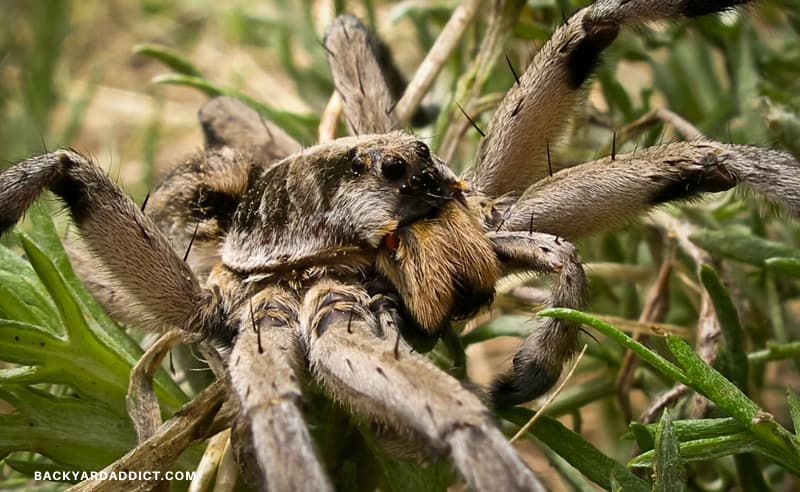
The wolf spider hunts at night. You can spot them by shining a light on the grass, and their eyes will reflect that light back. These spiders are typically brown, grey, black, or tan, with dark markings. The markings of the wolf spider and the grass spider are similar. If you put these two spiders side by side, you would see that wolf spiders have thicker stripes and do not have chevron markings.
Wolf Spiders have eight eyes arranged in three rows. There are four small eyes on the bottom row, two enormous eyes on the middle row, and two medium-sized eyes on the top row. Wolf spiders are different from most other arachnids as they have excellent vision that helps them spot their prey.
An average backyard may contain hundreds or thousands of wolf spiders, which feed on various insects and tiny organisms. You can often see wolf spiders in homes where they enter through gaps under doors.
The wolf spider does not spin webs. Instead, they dig small holes in the yard where they hide and wait for prey to come close so they can pounce. The wolf spider moves very fast. Their speed and sharp vision make them excellent predators.
Linyphiidae (Sheet Web Builders)
These spiders build unobtrusive webs near the ground. They are small, and most are under 1/8 inch in length. Their webs are curved or flat, and there is usually a tangle of knockdown threads either above or below.
The spiders tend to hang upside down under sheets. When something hits the web, the spider rushes out to catch it. The spider usually hangs under the sheet, so it bites through the web to trap and subdue its prey. The captured prey is dragged through the web, wrapped in more silk, then consumed.
These spiders have long, thin legs with sensory hairs. They have an oval or elongated abdomen. On the front of the cephalothorax are the fangs, the eyes, and two small “mini-legs” called pedipalps. Spiders use pedipalps to grab prey and mates! Each sheet web spider has eight eyes lined up in two rows of four.
The Autumn Money Spider is one member of this family found in residential turf grass.
Theridiidae (Cobweb Builders)
These spiders are the ones that are responsible for making cobwebs. Some of these work to trap ants and other insects that move on the soil’s surface. Their webs remain in place for extended periods and are repaired and expanded as necessary. You can often see these spiders hanging upside down in the middle of the web.
Weavers of cobwebs tend to have rounded abdomens that taper at one end. It makes the classic teardrop shape many people associate with spiders. Cobweb weavers have eight eyes arranged in two rows of four. Below the eyes are the mouth and fangs.
Females in this family tend to be larger than their male counterparts are. You can find a wide variety of colors in this family. Still, the majority are brownish-grey with various patterns of darker marks.
This group includes the common house and the infamous widow spiders. Fortunately, widow spiders do not usually live in the grass.
Are The Spiders In My Grass Poisonous?
Most spiders in the US are not harmful. There are a few poisonous spiders, but they don’t live in grass.
The only harmful spiders you are likely to encounter in your yard are
- Black Widow – usually found in woodpiles, crawl spaces, sheds, electrical, and irrigation boxes. The bites from these are very dangerous.
- Hobo spiders- found in many other places close to the ground with holes and cracks, such as rock retaining walls, in construction supplies, beneath the debris, and around building foundations. The bites from these spiders may cause nasty ulcers.
- Brown Recluse often hides in dark, secluded places, like under porches or deep closets. Yikes! They like to hide under debris and woodpiles in the garden. The bites from these spiders are very painful, and the side effects can linger for a long time.
- Yellow Sac – usually found in the wall-ceiling interface, around windowsills, amid the clutter, and behind baseboards. This is another spider whose bites may cause nasty ulcers.
As you can see, none of these spiders tends to frequent grassy areas, so you don’t have to worry about encountering them on your lawn.
Wolf spiders do live in the grass. They will not attack you or your pet but may bite if you accidentally step on them with bare feet. Bites are painful but do not pose health threats to people. You can protect yourself by wearing shoes.
Can Grass Spiders Harm My Lawn?
The good news is that spiders are unlikely to harm your lawn directly. In fact, they are likely to benefit your property because they eat hundreds (if not thousands) of the insects that harm your lawn.
Some people feel the webs are unsightly, but as we have seen, not all grass-loving spiders spin webs. In addition, most of the webs you will find in your turf are small and inconspicuous. It seems like a small price to pay for the enormous benefits these spiders bring. However, if the webs bother you, just keep your grass mowed, and you will see fewer of them.
Wondering how to get rid of other creepy crawlies? We can tell you how to kill ants in your grass and get rid of hoverflies without killing them.
Conclusion
Know that you know a little bit more about spiders in the grass, you can rest assured that they are not a threat to you or your lawn. Although spiders may seem scary, remember that most of them are harmless.
I hope this post has answered any questions about spiders in the grass. We’ve highlighted which spiders you are likely to find and explained why they make a home on your lawn. We’ve also shared some tips to help you get rid of them if necessary. To summarize, spiders in your grass are not a cause for concern, and they can be beneficial. Don’t worry about those eight-legged creatures that show up occasionally. They are working hard to control the insect population! If you have found this article helpful, we would be grateful if you shared it with other like-minded homeowners.
Footnotes and Sources
I work in an academic library, so I can access many scientific journals and books. When I write a post, I look at the scientific studies and books and use that information. I poured over dozens of spider descriptions and scientific studies to see which species lived in lawns in the United States and how to deal with them. This post is the result of about 7 hours of research.
- Dobbs, E. K., & Potter, D. A. (2014). Conservation biological control and pest performance in lawn turf: does mowing height matter?. Environmental management, 53(3), 648-659.
- Muma, M. H. (1973). Comparison of Ground Surface Spiders in Four Central Florida Ecosystems. The Florida Entomologist, 56(3), 173–196.
- Bradley, R. A. (2012). Common Spiders of North America. Univ of California Press.
- Cockfield, S. D., & Potter, D. A. (2017). Predatory insects and spiders from suburban lawns in Lexington, Kentucky. The Great Lakes Entomologist, 17(3), 11.