
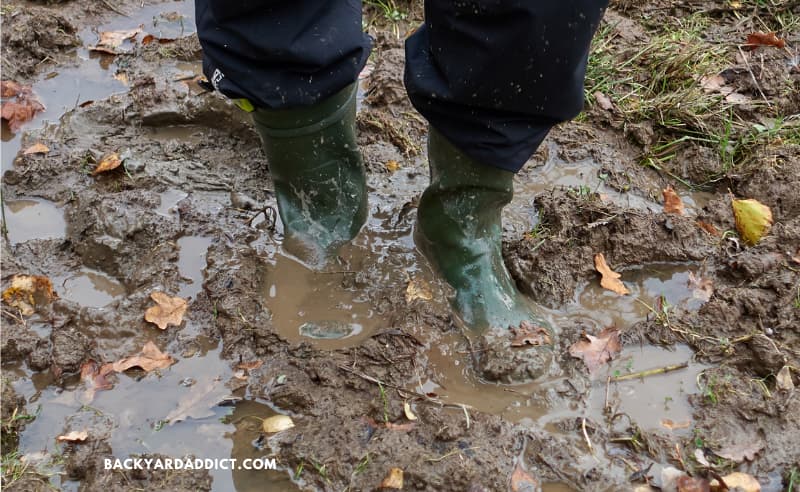
How To Cover Up Mud in Your Backyard For Good
The problem with muddy backyards is that they are just not aesthetically pleasing. When mud piles up on the ground, it can be challenging to deal with. But how do you fix the mess? We’re here to show you how to cover up mud in your backyard. The first step is to figure out the root cause of the mud and deal with that. Then cover up the mess by using one of these 9 simple techniques!

Gardening is a wonderful hobby, but it’s also frustrating when your backyard turns into a mud pit. You can’t enjoy your yard or host any gathering because it looks like a disaster area! Not to mention the mud that gets tracked into the house.
It’s time for some serious solutions that actually work! So, let’s get started with how to cover up mud in your backyard once and for all. We want to help you turn that muddy mess into a beautiful landscape again. We’ve got nine muddy backyard solutions that can help fix the problem and get you back to enjoying your garden!
What is Mud?
Most homeowners find mud to be a miserable nightmare. Mud is the soft, sticky substance that forms when soil, silt, or clay becomes saturated with water. It does have its uses. Certain kinds of mud can make pottery and building material, but the mud in the backyard is a nuisance. It makes a huge mess and basically leaves you with a yard that you cannot enjoy.
Where Are You Likely To See Mud In A Yard?
Mud will occur anywhere there is water and earth. This often happens when the ground is wet after heavy rain. Sometimes muddy backyards are caused by water runoff from the roof, seepage from irrigation systems, broken pipes, or inadequate drainage. Here are some common places to find it in your backyard.
- At the bottom of a slope where the water has run down into a low spot.
- Besides leaking faucet or sprinkler hoses
- At the end of downspouts where the water runs off
- Places where there is heavy foot traffic that has worn away the ground cover
- In flower or vegetable beds after a heavy rain
- Runs or pens where pets have damaged the ground cover
Dealing With The Root Cause
Before you can even think about how to cover the mud in your backyard, you need to find out what is causing it and fix that. Sometimes the source of the problem is apparent. If you have a low spot that collects water, then it is probably your culprit. However, if there is no apparent cause, you will need to dig a little deeper (pun intended)?
If you don’t deal with the water that is causing the mud, any covers you place over it will be a temporary fix.
Check out our step-by-step approach that can help you discover where the water in your yard is coming from.
Once you have dealt with the root cause, you can dry out your yard and cover up the mess.
How To Cover Up Mud In Your Backyard Quickly
Do you need a temporary solution while you work to find out why your yard is so wet? It is mud season, and you are tired of the mess trekked into the house by pets and family members. I’ve seen many solutions suggested that will only make matters worse.
We do not recommend the use of straw. It will leave a big soggy mess behind. Yes, it will soak up a lot of moisture and will eventually break down. However, it takes at least a season for the straw to decompose. Do you really want it strewn all over your yard? The most significant risk is that both hay and straw can contain the seeds of some pretty nasty weeds. You really don’t need to introduce those into your yard.
We would also be cautious about using cat litter. You would need a lot of the stuff to dry up most puddles. Besides, a lot of cat litter is made from clay, and you will end up with a bigger mess than you started with.
Here’s how to cover up mud in your backyard while you are waiting for it to dry out.
- Cover the mud with plywood until everything dries out. Obviously, you cannot cover the whole yard, but you can create boardwalks for family members to use as they walk across the yard.
- Keep pets and people out of the yard as much as possible. The feet will churn up the mud and possibly cause damage.
How To Cover Up Mud in Your Backyard: 9 solutions
Option 1: Lay Sod To Cover Bare Patches
Remember that any exposed soil will quickly turn to mud when the rain starts to fall. Laying sod is probably the fastest way to cover a large bare patch in your yard. If done correctly, laying sod can reduce the amount of mud you have to deal with and beautify your yard.
The sod will reduce how much exposed soil you have and how muddy your backyard gets if laid correctly. Most grass is water-thirsty, meaning the plants will soak up a lot of water. In addition, sod prevents soil erosion because its roots are deep and robust.
However, you can’t simply lay sod overtop of mud and expect it to grow happily ever after. You need to prepare the ground for getting that sod into place.
Depending on how big your yard is, laying down sod can be an expensive venture. It makes sense to do everything in your power to ensure this investment has a strong chance of flourishing into something beautiful and lush over time.
In a nutshell, you prepare the ground by removing all rocks, dirt clumps, and other obstacles. Grading your yard to ensure you have a good slope will also help water drain away. You may also need drainage. This video shows you how to prepare your yard for sodding.
Option 2: Overseed Existing Lawn
Family life can be rough on your lawns. Your lawn can be damaged by foot traffic and the weather. When a lawn ages, the grass grows more slowly and becomes thin, resulting in bare patches and mud.
Overseeding will help bring your lawn back to its former glory. As the seed germinates, the new grass blades will fill in the bare patches. Overseeding quickly re-establishes lush green grass without tearing the lawn out and starting over. It is a low-maintenance solution that requires little time and effort.
If you want more details about overseeding, you can read this helpful article.
Option 3: Attend to Lawn Maintenance
This posts contains affiliate links. This means we earn a commission from sales made via product links in this post. Read our full affiliate disclosure.
Aerating
Aerating your lawn improves water absorption and is also suitable for your grass. It relieves soil compaction, allowing water to soak into the ground instead of running off. A spike or core aerator will open small holes in your lawn to let air, fertilizer, and water get deep into the soil. You can rent these machines for a day if you don’t want to buy one.
Dethatching
Lawns are susceptible to a build-up of thatch. This is a layer of decomposing grass clippings that accumulate on the soil’s surface between the grass blades. A thick layer (more than ½ inch) can prevent water absorption and cause muddy conditions. Dethatching removes the thatch, so the soil can absorb the water better.
You need to use a dethatching machine or special rake to get rid of the thatch. You can often rent these machines for a day if you don’t want to buy one.
Option 4: Filling Low Spots
Low spots occur when your lawn is not properly graded. You will notice low spots in your yard after heavy rainfall because water will pool there, and that is where you will find the mud. You will probably find that children and pets will make a beeline for those wonderful puddles.
This article tells you how to fill small low spots in your yard.
In essence, you just need to fill in the low spot and reseed or plant a ground cover.
- Mow the grass and remove any thatch
- Mix up two parts sand, two parts topsoil, and one part compost to make filler
- Remove the sod from any low spots that are deeper than 2-3 inches. A sod lifter makes this task much simpler.
- Fill the hollows with the soil mixture and replace the grass.
- Water until the grass is re-established.
Option 5: Using Ground Covers
In gardens, plants act like sponges. Water collects on the leaves and canopy of these plants when it rains. Afterward, rain can seep into the ground or simply evaporate. The plant roots will also absorb a fair amount of water. It stands to reason that planting more trees, shrubs, and grasses will help prevent flooding and fix a muddy yard.
Ground covers are a popular way to avoid having to deal with mud in your backyard. These plants grow low and thick, creating an almost solid layer of foliage that protects the soil and prevents weeds.
The most significant advantage of these plants is that they are affordable, particularly if you grow them from seed. They are easily divided and replanted, so you may even get some from friends or neighbors at no cost.
They are also straightforward to maintain and take care of, making them an excellent choice for busy families who don’t have much time on their hands.
Here are a few tips
- Make sure the ground covers you choose will thrive in your growing zone.
- Make sure it is a plant that prefers poorly drained soil and can handle the moisture.
- Some ground covers can be very invasive. Check your state’s list of invasive plants before planting.lSome ground covers can be very invasive. Before choosing a plant, make sure it’s not on
- Install protective barriers between any ground covers and your lawn or perennial bed
- Read plant labels and do some research before planting. Some ground covers are pretty tender, so do not plant them in places with a lot of foot traffic. Others are tougher, so plant these along walkways.
This article provides more information about planting ground covers.
Here is a printable list of ground covers. They include some that can withstand moisture, including
- Bunchberry
- White dutch clover
- Birdsfoot Trefoil
Option 6: Build A Rain Garden
In a nutshell, a rain garden is a beautiful flower bed that also serves as a reservoir for water runoff from the roof and yard. They are made up of water-tolerant plants that thrive in wet soil and require more water to do well. It is an inexpensive method of protecting your backyard and dealing with mud at the same time.
You can create a rain garden by digging a depression in a low spot in the yard. Then directing runoff from the gutters and higher areas of the yard to this spot. Water is absorbed by the soil and used by the plants. Select plants suitable for your area and depth of water.
Locate rain gardens at least 10 feet away from your house and your neighbors’ home. Make sure you don’t place the garden over a septic tank or underground utility lines.
Pro tip: Don’t forget to contact 811 (national number) before digging.
Your rain garden needs to be deep enough to capture as much water as it will sink into the soil in 24 hours after a storm. This will vary depending on your soil type and how absorbent it is. Test your soil before you start digging to determine the ideal depth.
You need to make your rain garden depression at least 12 inches deep. The easiest way to do this is by digging a hole about 10 inches wide and 10 inches deep and fill with water. Then time how long it takes the water to go down 1/2 inch. If it takes one hour, you know the soil drains an inch every two hours. This tells you that your soil can handle 12 inches of water in 24 hours.
A rain garden should be sized according to how much runoff you experience.
This helpful article gives step-by-step instructions and tells you how to do those calculations.
Plan your rain garden with three zones: a wet area at the bottom, a middle area, and a transition area near the lawn edge. Choose plants that will thrive in each zone based on their water tolerance.
A well-designed rain garden collects the runoff and prevents flooding. The water-loving plants will thrive, and any excess water drains slowly into the garden. The garden will also attract wildlife and beneficial insects to your yard. This is one of the most beautiful ways to deal with the mud problem and prevent soil erosion.
Option 7: Use Mulch and Wood Chips
You will recall that mud forms when you add water to the soil. So, anything you can do to cover the soil in your yard will reduce the amount of mud created. Spreading wood chips or mulch is an excellent way to cover up the mud, form a barrier and prevent soil from running off.
Additional benefits of wood chips and mulch include :
- The addition of nutrients to the soil. Mulches decompose over time, adding vital nutrients back into the ground as they do so.
- Weed control, particularly if the wood chips are placed over a weed barrier.
- When your yard dries up, mulch prevents water evaporation and regulates the moisture in your flower beds.
- Wood chips are also known to inhibit disease and weeds.
You can purchase wood chip mulches at your local garden center. They come in various colors, sizes, textures, and grades, so you will have plenty of options depending on how much coverage you need!
Mulches work best in garden beds around shrubs and flowers, where you want to retain moisture in the soil.
We also used them in our garden to create inexpensive paths. They look great, feel lovely underfoot and last for some time. This post shows you how to make a wood chip path. We built our path between two raised beds and lined it with weed fabric.
This video shows how to use wood chips to create a soft surface for a playground area.
Option 8: Create A Dry Creek Bed
A dry creek bed is a landscaping feature designed to capture water runoff. The idea is to mimic the appearance of a dried-up creek bed. They consist of a shallow trench lined with landscape fabric and filled with boulders and stones of different sizes. During heavy rain, the water runoff drains through the creek bed to the collection point, where it slowly drains into the soil. The result is fewer pools of water in your yard and less mud.
In addition to providing drainage, a dry creek bed can also be a striking landscape feature that requires hardly any maintenance. You can design every aspect of the creek, from the path it takes to each boulder and stone placement. You can also add plants to the bed’s edges once it is in place. This will help make it look as if it has always been there. Here is video that shows you how to build a dry creek bed.
Many people design their dry creek bed to run off into a rain garden.
Option 9: Install Paths Over Dirt Paths
All gardens have paths, planned or otherwise. Most people will naturally take the shortest route from A to B, and the constant foot traffic can wear away the ground cover and create a dirt path. These will get muddy when it rains.
A simple way to cover up this muddy area is to install a walking path. These paths can be constructed from many different materials, including gravel and mulch.
The benefits of walking paths are not just aesthetic. Use them to define how you use the garden, connect separate areas of your yard, and make your garden more inviting.
- Add pavers, mulch, or gravel to cover up the path and create a more permanent solution that will stay in place longer than other materials.
- If you want something temporary (or less expensive), use wood chips and replace them as needed.
Obviously, you need to prepare the ground. You can’t just lay paving material over mud and expect it to work.
Here are some helpful resources
A Caution About Patios and Other Paved Areas
Naturally, you can cover up mud in your backyard by extending your hardscaping. The most obvious solution would be to install or expand a patio or create concrete pathways and courtyards. While it will certainly cover up the mud, it may cause more problems for you.
In 2016 scientists studied the impact of paved front yards on the flood burden in urban areas. Basically, gardens with paved gardens produced more water runoff. This is because these areas do not absorb water. All that water has to go somewhere, and you could end up with more flooding if you are not careful! If you are planning to install a patio or concrete driveway, consider installing a channel drain system at the same time.
What Is The Cheapest Way To Fix A Muddy Yard?
Wondering how to cover up mud in your backyard without emptying your bank account? The cheapest way to fix a muddy yard is to use plants. They act as nature’s sponges and do not need to be expensive. Putting in ground covers or even a rain garden can be very affordable. The most economical way to do this is to find family and friends willing to give you cutting or roots for free. After that, a package of seeds is very cheap. Growing your own plants is a very economical way of building up your collection.
Mulch or wood chips are other inexpensive options, particularly if you can find them for free. The best places to look are tree trimming services. There is a service called ChipDrop that connects gardeners with arborists. One other option is to find out if your municipality offers free mulch.
Final Thoughts
We hope this article has given you some ideas on how to cover up mud in your backyard. We recommend figuring out what is causing the muddy problems and dealing with that first. Then, have fun covering up the mud in your backyard as budget and time permits. We hope that our simple cover-up suggestions have inspired you to turn your yard from a mud pit into a beautiful, functional space.