
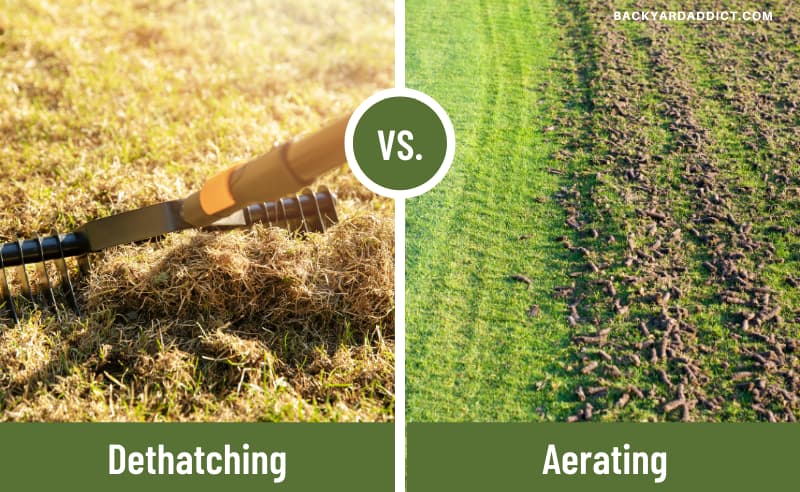
Dethatching vs Aerating: Which Is Best For Your Lawn?
Dethatching vs. aerating? Which is the right choice for your lawn? Both methods have their place in lawn maintenance, but one may be a better option for your specific needs. So, which one should you choose? Here’s all you need to know about these two lawn maintenance practices.

Dethatching Vs. Aerating
Has your lawn gone from a green oasis to a dry, thin patch of struggling grass? It is probably time to consider dethatching or aeration. But what’s the difference between the two? How do you know which treatment is best for your lawn at any given time?
Comparing these two lawn care practices will give you a brief overview and help you decide which is best for you. Remember every lawn is unique and may require different levels of care. Dethatching vs aerating- this table sums up the differences.
Want more details? Click on the links in the table and jump straight to the appropriate section in the post.
| Dethatching | Aerating |
| Dethatching involves removing excess thatch layer between the soil and grass tips. | Aerating involves perforating the soil and pulling out plugs of dirt and grass |
| Done to take away the layer of thatch smothering your grass | Used to alleviate compaction. |
| Use a dethatching rake, dethatching machine or power rake | Done with a core or plug aerator |
| The best time to dethatch is during the peak growth period for your grass. | The best time to aerate is during the peak growth period for your grass. |
| Signs your lawn need dethatching include spongy feel to lawn, less tolerance for temperature extremes, and lawn looks dry | Signs of compacted soil include stunted, thin grass, bare patches and increased weeds. |
| Dig and measure, or do the finger test to see if you need to dethatch. | Use the screwdriver test to see if you need to aerate. |
Dethatching vs Aerating-What Is Lawn Dethatching?
Thatch is a layer of dead and living grass that builds up on your lawn and other organic matter over time. A small amount of thatch is normal and beneficial to your lawn, but too much thatch can lead to a number of problems. Dethatching is the process of removing the thatch layer from your lawn.
The Benefits Of Lawn Dethatching
Dethatching removes thatch, a layer of dead grass and stems that forms on the soil surface. This has many benefits, including
- Improving water absorption, which helps your lawn stay healthy and green
- Allowing nutrients, water, and air to reach your soil, improving the health of your lawn.
- Exposing the blades of grass to sunlight and promoting growth.
- Reducing water runoff and standing water.
All of these things are good things for your lawn. However, the process of dethatching can be pretty stressful on grass. For more information on this, read our post about the pros and cons of dethatching your lawn.
Dethatching vs Aerating-What Is Lawn Aeration?
Lawn aeration is the process of perforating the soil and pulling out plugs of dirt and grass. These are then left to break down on the lawn. The main reason for aeration is to alleviate compaction.
Soil compaction occurs when the soil particles are tightly packed together, reducing the number of air spaces between them. These spaces are vital because they allow water, air, and nutrients to reach the grassroots. The compacted soil is also much harder for roots to push through.
Compaction makes it harder for the grass to thrive, so you will reduced plant growth, a lack of drainage, and increased water runoff.
The Benefits Of Lawn Aeration
Aeration provides many benefits that can significantly improve the health and appearance of your lawn. Aeration
- Relieves soil compaction. Most plants do not thrive in compacted soil. This can lead to thinner, weaker grass that is more susceptible to disease and pests.
- Increases nutrient availability by allowing water, air, and nutrients to penetrate deeper into the root zone.
- Encourages better drainage, which reduces the likelihood of water runoff (leaching nutrients away) or standing water.
- Encourages the roots to expand and stimulates new growth. This leads to a thicker, lusher lawn.
What Lawn Conditions Cause Excess Thatch or Compaction
Soil Conditions That Cause Build Up of Thatch
Your lawn is more likely to need dethatching if you face the following scenarios.
- Lack of earthworms-Earthworms are the gardener’s friend. Not only do they aerate your soil, but they love to feast on the organic material that forms thatch. This, of course, prevents the thatch from getting too thick.
- Too much Nitrogen- Grass needs nitrogen to thrive, but too much can cause increased growth, leading to thatch buildup. Avoid this by doing regular soil tests and using the results to determine how much fertilizer you need. Kits for testing the soil are easy to use.
- Soil with higher acidity- Thatch occurs when organic material builds up faster than it can break down. According to the University of Kentucky Extension Service, the microorganisms that help with decomposition thrive in a neutral pH range.
- Growing grass produces more thatch- certain species of grass create more thatch. These include Kentucky Bluegrass, zoysia, Bermuda, and Creeping Bentgrass.
Soil Conditions That Cause Compaction
Your lawn is more likely to need aeration if you face the following scenarios.
- High clay content – https://www.thisoldhouse.com/gardening/21016812/how-to-plant-a-flower-bed-in-clay-soilClay soils are made from tiny particles with few air pockets. This makes them heavy, dense, and prone to compaction.
- Heavy foot traffic: these kinds of lawns are more likely to need aeration because the weight of foot traffic compresses the soil.
- New home: Construction companies tend to remove the topsoil on construction sites. When finishing up, they lay the grass over subsoil, which is often poor quality. In addition, the soil at a building site can be compacted due to all the construction activities.
- Sod and soil layering- Soil layering often occurs when there is a lack of proper soil preparation. Sod is simply laid down over existing soil. This can cause poor drainage, which can lead to soil compaction.
Signs Your Lawn Needs Dethatching Or Aerating
Your lawn will usually tell you whether it needs dethatching vs aerating. Here are some signs and symptoms to watch for. We also have some tests that you can do to be 100% sure.
Does My Lawn Need Dethatching?
Here are some classic symptoms of a lawn that needs dethatching.
- Your grass looks dry even after watering. It may also have dry patches.
- Lawn has a “spongy” feel as you walk across the lawn. In extreme cases, you may spot footprints left in the grass after someone walks on it.
- You find yourself having to deal with more insect infestations and diseases.
- The grass quickly wilts or shows stress in extreme cold or heat.
Does My Lawn Need Aeration?
Here are the signs your lawn needs aeration.
- Your lawn feels very dry and hard when you walk over it.
- There may be bare patches on your lawn where the soil is compacted.
- After heavy rain, you will notice increased runoff or pooling of water due to the decreased drainage.
- You may see an excessive buildup of thatch as the organisms that break down organic matter cannot thrive in compacted soil.
Finding this post helpful? See all our lawn care articles.
Dethatching Vs. Aerating Tests
The symptoms described above are a good indication that your lawn needs treatment. Seeing the signs, but still debating dethatching vs aerating? Want to be entirely sure? Conduct the following tests.
Test For Compacted Soil
Push a wire flag into the soil where you want to test. Measure the point at which the wire bends. The faster it bends, the more compacted the soil.
Alternatively, take the “screwdriver” test. All you need is a screwdriver about 4 to 6 inches long. Now try to push it into your lawn. If it is too hard to push it in all the way, you have compacted soil.
Measure The Thatch
Experts say that the depth of the thatch is critical. It should measure less than 1/2 inch in warm-season grasses and 1/3 inch in cool-season grasses. As a general rule
- Thatch under 1/2 inch? Good news, you don’t need to dethatch.
- More than 1/2 inch? You do need to dethatch.
Using a shovel or other instrument, excavate several turf plugs. Dig down far enough to remove the turf and thatch and some of the underlying soil. Then measure the thickness of the thatch from the dirt to the top of the layer.
You can use the finger test if you don’t want to dig up your grass. Although it isn’t as precise, it provides a pretty good measurement. Push a finger through the thatch layer gently until you feel the soil. Make a mark on your finger where it meets the top of the thatch layer. Now measure from your fingertip to the mark.
How Can I Dethatch My Lawn?
If you have a small lawn, you can use a dethatching rake. You will probably appreciate a power rake or dethatcher if you have a more extensive property. You can usually rent these if you don’t want to buy and store a machine.
Once again, mark any shallow irrigation/utility lines and sprinkler heads as you don’t want to damage these.
Start by mowing your lawn to half its standard height before you begin dethatching.
Dethatching rakes have sharp tines that dig into the thatch and pull it upwards, loosening the buildup and making it easy to remove. You will see and feel the thatch lifting up from the soil.
If you are using a power rake, check the manufacturer’s instructions to adjust the machine for your particular grass. A power rake will remove a considerable amount of thatch, but the inexperienced user can damage their lawn. If you feel a little nervous about using one, you may want to opt for a dethatcher. This lighter-weight machine removes about 1/2 inch of thatch and is less likely to damage your lawn.
Tips For Dethatching A Lawn
Again timing is essential.
- February and March, for the warm-season lawn. This is just before green-up.
- Late September through to mid-October for cool-season grasses.
How Can I Aerate My Lawn?
1 inch of water should be applied the day before aeration to soften the soil.
Call before you dig to make sure you know where utility lines are. You also want to note any sprinkler heads, shallow irrigation, or septic lines so you don’t accidentally damage them.
If your soil is lightly compacted, one pass with the aerator will be sufficient. As always, follow the instructions for use.
On the other hand if your soil is badly compacted (or this is the first time for aeration), go over the entire lawn twice. The second pass should be done perpendicular to the first.
The aerator will remove small plugs of soil. You do not need to do anything to them as they will quickly break down, and the nutrients will return to the earth.
Tips For Aerating A Lawn
There are two main types of aerators, spine and core/plug aerators. Spine aerators simply poke a hole in the grass, and core/plug aerators remove small plugs of soil from your lawn and leave them on the surface. Experts recommend using core/plug machines as the spine aerators can cause more compaction.
Almost all the machines and tools I could find for sale are a spiked variety. Therefore, I recommend renting a core/plug aerator when you need to do this job.
Timing is vital as you want to do this job when your grass is actively growing, so it has time to recover. This would be
- Early spring or fall for cool-season grasses
- Late spring through early summer for warm-season grasses
To find out more about warm and cool-season grasses, read our post on the different types of grass.
Aerate after rain or watering so that the soil is soft.
FAQ
Can Dethatching Hurt Your Lawn
Dethatching will stress your lawn. It may damage your grass and cause thinning. It can also provide a window of opportunity for weeds. For these reasons, dethatching should only be done when the thatch gets too thick.
What Do I Do After I Dethatch My Lawn
The first thing to do is rake up the thatch and dispose of it. We recommend composting it or taking it to a composting site if you can. Dethatching is hard on grass, so your lawn may look worse for wear afterward.
Top dress and consider overseeding any noticeable bare patches or places where the grass looks thin. Water and fertilize as needed. Keep an eye out for weeds, as they will love those bare patches. Deal with those nasties before they get established. Your lawn should recover quickly and be back to normal in no time.
Should I Aerate Or Dethatch First?
It is best to dethatch your lawn before aerating. Removing the thatch will allow the aerator to penetrate deeper into the soil and do a better job.
Final Thoughts On Dethatching Vs Aerating
Dethatching vs aerating which one will benefit your lawn? Only you can decide. By understanding what your lawn needs and how to provide it, you can keep your yard looking lush and healthy. If you’re still unsure what to do, look around the neighborhood. Who has a fantastic lawn? Ask the owner for advice. Most gardeners are happy to share their experiences and are flattered to be asked. As always, thanks for reading. If you enjoyed this post, please take the time to share it.