
Plant Growth Stages 101: Learn How Your Garden Grows
Gardening is a rewarding hobby, but it’s important to understand the different stages of plant growth to provide your garden with the proper care. Every plant goes through the same life cycle, regardless of its species. Knowing what to expect at each stage can help you better care for your plants and ensure a healthy garden.

This post is part of my Gardening Basics series. Here you’ll find everything you need to understand the fundamentals of gardening.
The time it takes for a plant to reach maturity may vary, but they all follow the same patterns. So let’s take a closer look at plant growth stages and what they mean for gardeners.
1. Seed Stage
Every flower starts life as a seed. Even those that are propagated once began life as a seed. The seed contains everything it needs for the plant to grow and mature.
Inside the seed is the plant embryo, which contains the plant’s genetic material. This information will determine the plant’s characteristics, such as height, flower color, and leaf shape.
Also inside the seed is the endosperm, a food source for the embryo. Once the seed germinates or starts to grow, the embryo will begin to use the endosperm as fuel for growth.
The Cotyledons are also stored in the seed. These are leaf-like structures that contain the endosperm and are different from the true leaves that the plant will grow later.
The final component of the seed is the seed coat. This is a protective layer that helps the plant to survive until conditions are suitable for germination.
The seed stage is essential, but it’s just the beginning of the plant’s journey. Let’s take a look at the next phase of plant growth.
2. Germination Stage
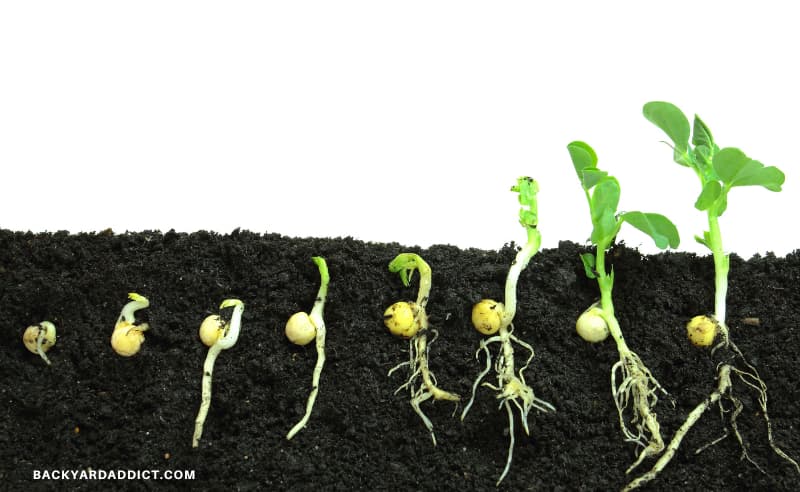
The germination stage is when the plant first starts to grow. The seed coat starts to absorb water and swells and bursts open. Then the plant embryo inside the seed uses the endosperm as fuel and begins to grow. At this point, the plant still depends on the seed for food.
For germination, you need three things: water, oxygen, and the proper temperature. If one of these conditions is not met, germination will not occur.
Always check the seed package for directions. Some plants need light to germinate, and others need to be buried. Some seeds need to experience a period of cold before they germinate. A few seeds need to be soaked overnight before planting.
Once germination has started, it’s essential to keep the plant moist but not too wet. Too much water will cause the plant to rot. The best way to water plants at this stage is with a spray bottle so the water can be applied evenly without disturbing the plant.
In our garden, we use a drip hose so that the water can be applied evenly without disturbing the plant. If we are starting seeds inside, we use these self-watering seed starter trays and a seed starter mix. Do not use potting soil at this point because it holds too much water.
The germination stage is a critical time for a plant. Your plant will get a solid start if you provide the proper conditions for germination.
Finding this post helpful? Take a look at our other posts about flowers
Sprout
Once germination occurs. The first thing to grow is the root. A tiny white sprout called a radicle grows out of the seed and begins to grow down into the soil. Its role is to anchor the plant and take up water and nutrients.
Seedling
Once this is in place, the plant will begin to grow the beginning of a stem. This is quickly followed by the leaf-like structures called cotyledons. These contain the stored food the plant uses until it can start making its own. The cotyledons are different from the true leaves that the plant will grow later. In some plants, the cotyledons can help with photosynthesis.
3. Vegetative Growth Stage
During the vegetative growth stage, the plant will focus on growing leaves, stems, and roots. At this point, the plant is most vulnerable to stressors such as temperature extremes, drought, and flooding.
Vegetative Stage Growth
Above ground, the plant grows taller and develops a thicker stem. Below ground, the roots continue to grow and spread out. They also become more efficient at collecting water and soil nutrients.
Plants start to develop distinct characteristics that help us to identify them. For example, the shape of their leaves, the color of their flowers, and how tall they will grow.
Photosynthesis
Photosynthesis is an essential process that enables plants to transform sunlight into chemical energy. This energy is stored as sugar, which the plant can use to grow and reproduce.
The process of photosynthesis begins when light strikes the leaves of a plant. This light energy is converted into chemical energy (sugars) by special cells called chlorophyll.
The plant uses sugar to create new cells, produce fruits and vegetables, and grow roots and stems. Photosynthesis is a complex process that is essential for the survival of plants. Without it, there would be no food for animals or humans to eat.
Root Growth
Roots are the part of the plant that anchors it in the ground and takes water and nutrients from the soil. The roots grow downwards, away from the light, and spread through the soil.
As the plant grows, its root system will also develop and become more efficient at taking up water and nutrients. The roots are an essential part of the plant and play a vital role in the plant’s well-being.
In this stage, the plant focuses on growth and development. It is preparing itself for the next phase of its life cycle.
What To do In The Vegetative Plant Growth Stage
There are some things gardeners can do to help their plants thrive at this stage.
- Water plants regularly, making sure to not overwater them.
- Fertilize the plants with good quality plant food. Nitrogen encourages leaf growth and is needed for photosynthesis. Potassium encourages stem growth, while Phosphorus and Potassium encourage healthy roots.
- Protect the plants from pests and diseases.
- Check the plants for signs of stress (such as wilting leaves) and take action to correct the problem.
4. Reproductive Plant Growth Stage
The plant has now reached the adult stage of its life cycle and is ready to reproduce. This happens at different time intervals depending on the type of plant.
- Annuals will complete the vegetative stage and move on to flowering in one growing season.
- Biennials will complete the vegetative stage in one growing season and then enter a period of dormancy. The plant will remain dormant until the next growing season, when it will flower.
- Perennials can take two or more years to reach this point.
- Trees can take many years to reach this point.
Once the plant has reached maturity and is ready to flower, it will enter the reproductive stage of its life cycle.
Budding
As a plant matures, it starts spending energy on flowers and eventually fruit. This first part of this process is known as budding. Buds contain the plant’s reproductive cells and will grow into flowers, essential for reproduction.
Interested in basic garden knowledge? Check out our post about the anatomy of grass.
Flowering
Slowly the buds unfurl into flowers. Flowers are the plant’s reproductive organs and contain the plant’s pollen. This is an important time for the plant, as it uses these flowers to reproduce through pollination.
Pollination is the transfer of pollen from the plant’s male reproductive organ (stamen) to the female reproductive organ (pistil). This process can be done by wind, insects, or other animals.
Pollination is necessary for the plant to create new seeds, eventually growing into new plants. This often considered the most visually appealing phase in the plant growth stages. It is one of my favorites. I love flowers.
A few of the many flowers in our garden. Can you spot the pollinator?
What To do In The Flowering Plant Growth Stage
Continue to water and fertilize the plant regularly. At this stage, the need for nitrogen decreases. Potassium encourages the development of flowers and fruits and general plant health. You can purchase fertilizers specifically to promote flowering and fruit development.
As the flowers ripen and produce seed, they signal to the plant that the reproductive work is done. At this stage, plants stop producing buds. Deadheading spent flowers encourages new blooms if you are growing plants for their flowers.
5. Ripening
After pollination, the plant’s flowers start to produce fruit. The fruits contain the plant’s seeds. This is the final stage in the plant’s life cycle and marks the beginning of a new generation of plants.
In the vegetable and fruit gardens, this is the most productive of all the plant growth stages. Gardeners can finally begin to harvest their crops. This is also an excellent time to gather some of the seeds. So, you are ready to start a new batch of plants the following year.
What To Do In The Ripening Plant Growth Stage
Water the plants well while they bloom and produce fruit to ensure that they remain healthy. Plants that get stressed will drop their buds or fail to produce fruit.
Continue to ensure that plants receive the correct amounts of Potassium. This helps the plants set fruit and keep it healthy as the fruits ripen.
Seed Dispersal
Once the plant has ripened its fruit and produced seeds, it is time for seed dispersal. This is when the plant’s seeds are scattered so that they can grow into new plants.
There are many ways that seed dispersal can occur, but the most common method is by animals eating the fruit and then passing the seeds in their droppings.
Other methods of seed dispersal include:
- Wind (Like Maple trees or Milkweed)
- Water (Like Yellow Flag, Mangos)
- Explosion (like Flax or caragana)
What To Do In The Seed Dispersal Plant Growth Stage
This really depends on the plant. As the days get shorter and colder, they begin to move the sugars from the leaves to the roots to overwinter. Those that will regrow in the following year will be starting to prepare for dormancy. It is important to keep watering right up until the ground freezes.
In the vegetable and fruit garden, this stage equals harvest time. All of your hard work has paid off. Now it is time to enjoy your labor’s fruits (and vegetables).
If you are harvesting seeds to plant in the following year, let the plant’s fruits mature fully. This will ensure you get fully formed fruit and viable seeds.
6. Death or Dormancy
This is the final stage of the plant growth cycle until growth begins anew in the spring.
Plants will either die at this stage or enter a period of dormancy where growth stops until the following spring. Dormancy is similar to hibernation in that the plant processes slow down or stop altogether. Many plants lose their leaves during this time as well. This is perhaps one of the dullest parts of the plant growth stages, but it is essential for healthy growth.
At this stage, the differences between the types of plants become more apparent.
Annuals go through all the plant life growth stages in one growing season. They often die back once the cold weather and frost arrive. They need to be replanted from seed to grow again.
Biennials go through the germination and vegetative growth stage in their first year. In their second year, they flower, set seeds, and die.
Perennials can live for many years. The plants will die back to their roots when the cold weather comes. However, the plant itself is still alive. The plant will regrow from the roots in the spring. Then the plants go through the vegetative growth, flowering, and ripening stages again. They will continue to repeat this cycle as long as they survive the winter.
Larger plants like trees can live for hundreds of years. They do not die back to their roots each winter. However, deciduous trees lose their leaves and go dormant each winter. The plant grows back from leaf buds on the branches each spring. Then the plants go through the vegetative growth, flowering, and ripening stages each year. Coniferous trees do not lose their leaves but slow down in the winter.
What To Do In The Death or Dormancy Plant Growth Stage
This is the time of year to prepare your garden for the winter. If you have annual plants that will not regrow in the spring, pull them up and compost them. This will help add nutrients back into the soil for the following year.
If you have not already done so, now is the time to harvest any remaining fruits and vegetables.
Clean up any debris from around your perennials. You can cut down stems and remove dead leaves. However, I prefer to do it this spring as the dead leaves and debris give winter shelter to beneficial insects like ladybugs. Keep watering your perennials until the ground starts to freeze, as this will prepare them for the long winter.
If you are harvesting seeds, this is the time to do it.
Final Thoughts
That’s it for now! We hope this post has helped you understand the plant growth stages better. It’s helpful to know what each step looks like to provide the proper plant care at the right time. Now it’s time to put this knowledge into practice. Start by observing your plants and note how they are growing. See if you can identify what stage they are in. Now use the information to do what needs to be done. If you found this post helpful, please consider sharing it with others. As always, thank you for reading.