
How to Keep Birds from Eating Grass Seed: 4 Proven Methods
If you’re a gardener, then you know how frustrating it can be to seed your lawn only to watch the birds gobble everything up. But how to keep birds from eating grass seed? We’ve searched the scientific studies to find out which methods work. We’ll also tell you which are a waste of money. Read on to discover how to keep those hungry birds away from your grass seed so it has a chance to germinate!

Most gardeners enjoy having birds in the garden. However, there are times you need to keep them away from specific areas. A newly seeded lawn is one of the times. You know those birds will love the free food, so how to keep birds from eating grass seed?
You’re not alone in your desire! Many gardeners have tried everything from predator decoys to nets to motion-sensitive sprayers. But what really works? Do these methods really keep birds away? Are they worth the time and money? We’ve hit the scientific studies to find out for you!
Our guide provides a quick evaluation of the many common bird deterrents and sorted out the ones that work. All our recommendations are scientifically proven, so you can rest assured they will do the job! We’ll tell you which ones will protect your seed and which ones will not.
Why Are Birds Eating My Grass Seeds?
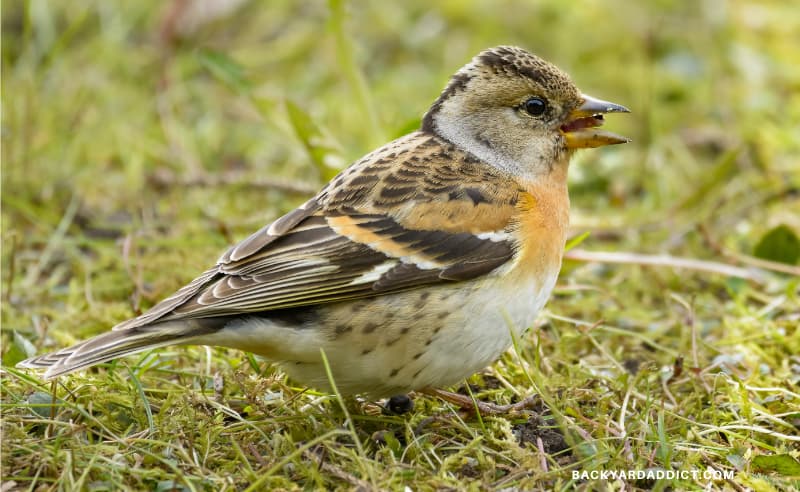
Your garden is home to many granivorous birds. Granivorous is a fancy term for birds whose diet consists of seed and grain and includes birds like sparrows, doves, and finches. They will all be happy to feed on your grass seed. It is the ideal food for them.
Like most animals, birds are opportunistic feeders. In a nutshell, they want to get the food they need with the least amount of effort. What could be easier than just sitting on a lawn and eating freshly sown seed? In many respects, your newly seeded lawn is an all-you-can-eat buffet. And they don’t have to pay an entrance fee!
Unless you are willing to stand to watch 24 hours a day, you must protect your grass seed, and we will show you how to do that.
How Long Does it Take For Grass Seed to Germinate?
Each grass type and variety has a different natural germination speed. It can take two to three times longer for cool-season Kentucky bluegrass varieties to germinate than tall fescue varieties. Warm-season Zoysia grass can take up to three times longer than Bermuda grass.
However, as a rule, whether you’re overseeding an existing lawn or beginning from scratch, grass seedlings will generally emerge within 7 and 21 days when grown under ideal conditions.
Check your seed package to see the estimated germination times for your seed type. That is how long you need to keep the birds away.
How To Keep Birds From Eating Grass Seeds
Use Covers To Hide or Protect The Seed
A physical barrier between birds and grass seed is one of the most effective ways to keep them from eating it. Some barriers completely cover the seed and prevent birds from seeing it.
Other types of covers don’t hide the seed but instead act as a barrier to prevent birds from reaching it.
You can use the following covers to protect your seeds.
Use Straw Mulch
Mulch is an excellent choice for covering up grass seed and protecting it from the birds. Mulch also helps retain soil moisture, prevents movement of seed, and moderates soil temperatures. However, you do need to be cautious about the type of mulch you use.
Poor quality mulch can suffocate your seed, introduce weed seeds and cause diseases. The experts at Michigan State University recommend the use of straw. Straw is the dry stalks of cereal plants left over after the grain and chaff have been taken away. Use wheat, oat, or barley straw that is cleaned of all seeds.
Spread the straw so that there is only a thin layer. You should be able to see the soil surface between the straw stems. This will usually require about two 60-pound bales per 1000 square feet of lawn space. Anything deeper may smother the seeds.
Finding this post helpful? See all our lawn care articles.
Burlap Sheets
This posts contains affiliate links. This means we earn a commission from sales made via product links in this post. Read our full affiliate disclosure.
Burlap fabric is also suitable as an alternative mulch. It is a type of loose-woven fabric that will cover the seed and allow water to get through. Burlap is a good choice when soil temperatures are cold as it keeps the heat in. Burlap provides weed-free, uniform coverage but can be time-consuming to install and must be anchored with pins. It is probably not the best choice if you have a large area to cover as it becomes expensive fast. Remember, newly germinated seeds are delicate and need light to survive. Burlap will block most of the light from getting through. Therefore, it is essential to remove it immediately after germination, so you need to check every day.
Netting
When I researched the studies for this post, I found that covering crops with nets is probably the most effective bird deterrent.
It is easy to find bird nets, and they work well for protecting all kinds of crops. We stretch them over our Haskap bushes to prevent birds from eating all the berries. It works really well.
You need to lift the netting a few inches above the ground with wooden stakes. It will prevent the birds from reaching the seed through the holes in the net. Stretch the netting tight, so the bird doesn’t get tangled in it. Check that the netting hangs over the edges of your protected area. Secure it, so the birds cannot get under the net.
The advantage of netting is that it protects the seed while giving it water and light. Use the bird net to cover vegetables and fruit crops in your garden when you no longer need it over your grass.
Covers That Cause Problems
The following covers probably will not work well. We would advise caution.
Soil
The idea here is that birds are instinctively attracted to seed, so any seed visible on top of the soil will be a target. Therefore you need to cover or bury your grass seed by raking over the surface after sowing. This ensures that no seeds are left exposed for birds to see. It sounds good in theory, but it could do more harm than good.
This because grass seedlings aren’t strong enough to actually penetrate through too much soil. This is why we scatter grass seed on top of moist, aerated soil and leave it alone to grow. Germination rates may suffer if you rake the seed too deep or cover them with too much dirt. Unfortunately, it doesn’t take much dirt to kill them.
Plastic Sheeting
Transparent tarps are basically plastic sheets. Supposedly they are suitable for sowing grass seeds in colder weather. This is because they act like a greenhouse trapping the heat underneath.
The problem is there is no way of controlling the temperature under the tarp. So, you may end up baking your seeds and killing them.
Many people use Transparent tarps for a process called soil solarization. This is an organic method of controlling soil-borne weeds and insects. You use clear plastic tarps to trap the heat of the sun in the soil. It gets hot enough to kill most weeds, nematodes, and insects in your soil.
Do you see the problem here? If it is hot enough to kill weed seeds, it will also bake your grass seed to a crisp. We recommend keeping the transparent tarps for weed control and keeping them far away from your grass seed.
Bird deterrents
This is an entirely different way to keep birds away from your grass seed. The goal is to scare birds off rather than hiding the seed under a barrier.
Reflective surfaces
Mirrors and reflective objects supposedly work on the idea that unexpected flashes of light startle the birds and frighten them off. There are a variety of products available, from pinwheels to balloons to mylar ribbons.
However, this doesn’t seem to be a particularly effective deterrent and only has limited success.
Some studies found that reflecting tape stretched over agricultural crops kept birds like sparrows and red-winged blackbirds away but was ineffective against goldfinches and doves. The biggest problem is that most birds became used to reflective devices after about 7 days, and they no longer work after that. This is not enough time for most grass seeds to germinate.
One study found that reflective objects can help deter birds if food is available elsewhere. So, try installing a bird feeder away from your seeded lawn. Make sure you keep it stocked.
Motion Sensitive Sprayers
In theory, motion-activated water sprayers scare off birds by spraying them when they get too close. It seems like an ideal solution, but how well do these devices work?
I couldn’t find any scientific studies using these devices as bird deterrents. We’ve used them to scare away deer from our yard. I have seen them go off when birds trigger the motion-sensitive detector, and they do seem to work.
Please note that they will go off when anything moves in front of the sensor. So, be mindful of where you aim the sensors and spray jets! You probably don’t want to blast your passing neighbor with water, no matter how great the temptation.
Seeds Coated in Bird Repellent
Some companies offer seeds treated with bird repellent. This product tastes horrible, and the idea is that birds will learn to avoid seeds coated with it.
I went looking to see if there was any evidence to back this up and found mixed results. There were no studies involving grass seed specifically, so keep that in mind. I found a study that suggested seeds coated in hardened clay were effective as it was harder for birds to crack and eat. So, it might be worth looking for seeds that have a coating of some kind. Do bear in mind that the coating will soak up the moisture from watering and may not last long. I would use them in tandem with netting.
It also appears that the repellent anthraquinone is quite effective at repelling birds. If you see grass seed covered in repellent at your garden center, check to see what it is. Ask if they can point you to any information about the chemical used. Personally, I would not spend extra for anything treated with bird repellent. Most of it will wash off in the first watering.
Deterrents That Do Not Work
Noise deterrents
Devices that use ultrasonic sound waves are often featured on the recommended lists of bird deterrents. But there is no evidence that these devices actually get rid of birds. In fact, research indicates that most birds do not hear in the ultrasonic range, so these kinds of devices will not work.
Horns and other high-intensity sounds at close range can cause distress and encourage birds to flee. However, these kinds of devices are likely to make you very unpopular with your neighbors and are best avoided.
Some people recommend using a device that plays hooting or screeching sounds to frighten the birds and make them leave. Yet, studies found these kinds of sounds were not effective at scaring birds away. Hawks and falcons hunt silently, so other animals are not going to associate their calls with danger. Moreover, birds quickly become accustomed to these sounds, so they become ineffective very quickly.
Predator Decoys
Predator decoys are a visual deterrent that mimics the form and motion of potential predators. In theory, their appearance and movement frighten away birds. But studies tend to show that they do not work as well as hoped.
Scientists think that this is because static models don’t display the typical behavioral cues. These are what triggers fear in potential prey.
Decoys that get moved to a different location each day are a little more successful. But in the main, birds quickly learn that these are not real predators and ignore them. It is unclear if they would be effective long enough to allow germination, but they really aren’t worth your hard-earned cash.
Scarecrows
Scarecrows are designed to frighten birds away by mimicking the presence of humans. They have been used for centuries and remain a popular backyard deterrent, but how effective are they? In a nutshell, most static scarecrows are ineffective. Still, they do make cute garden decorations! Birds quickly learn that they don’t pose a threat.
A study from 1988 reported scarecrows made from black plastic bags attached to wooden stakes worked well. As long they were put into place before the birds arrived. The plastic flaps in the wind, which seems to work long enough for the seed to germinate. This post shows you how to make one.
It appears that scarecrows dressed in loose clothing that flutter and make noise in the wind may be more effective. You might also add long streamers that flap around in the wind. I did find mention of an inflatable scarecrow called Scary Man that inflates rapidly and deflates at regular intervals. It seemed to be an effective deterrent for the short term. However, I could find any suppliers. Still, the video is entertaining!
What Methods Are Scientifically Proven To Keep Birds From Eating Seed?
We’ve reviewed most of the popular suggestions for how to keep birds from eating your grass seed. As you can see, not many of them are scientifically proven to work. The following methods will keep the birds away long enough to allow germination. In order of effectiveness
- Netting stretched tight and lifted 2-3 inches above the ground.
- A thin layer of straw mulch
- Burlap fabric, but be sure to remove as soon as seeds sprout.
- Reflective devices when combined with providing an alternate food source.
In addition, the water-sensitive sprinklers do seem to work. I couldn’t find any research to back this up, but I witnessed these devices deter birds in my own garden. In addition, many customer reviews on Amazon indicate that these devices do send birds packing.
Conclusion
Knowing how to keep birds from eating your grass seed is vital if you want to grow a nice thick lawn. There are many suggested methods for deterring birds, but many of them are not effective. Fortunately, we found 4 ways that are scientifically proven to work. 3 out of the 4 need you to cover up the seed and keep the birds away.
So now, all you need to do is plant those seeds and get your defenses ready. You can rest assured that your seeds are protected until they germinate. Then they can grow into a lawn you can be proud of!
Need to keep Other Critters Away?